


Health Monitoring & Daily Care
Reflexology Rock Foot Massage Mat
Reflexology Rock Foot Massage Mat
Couldn't load pickup availability


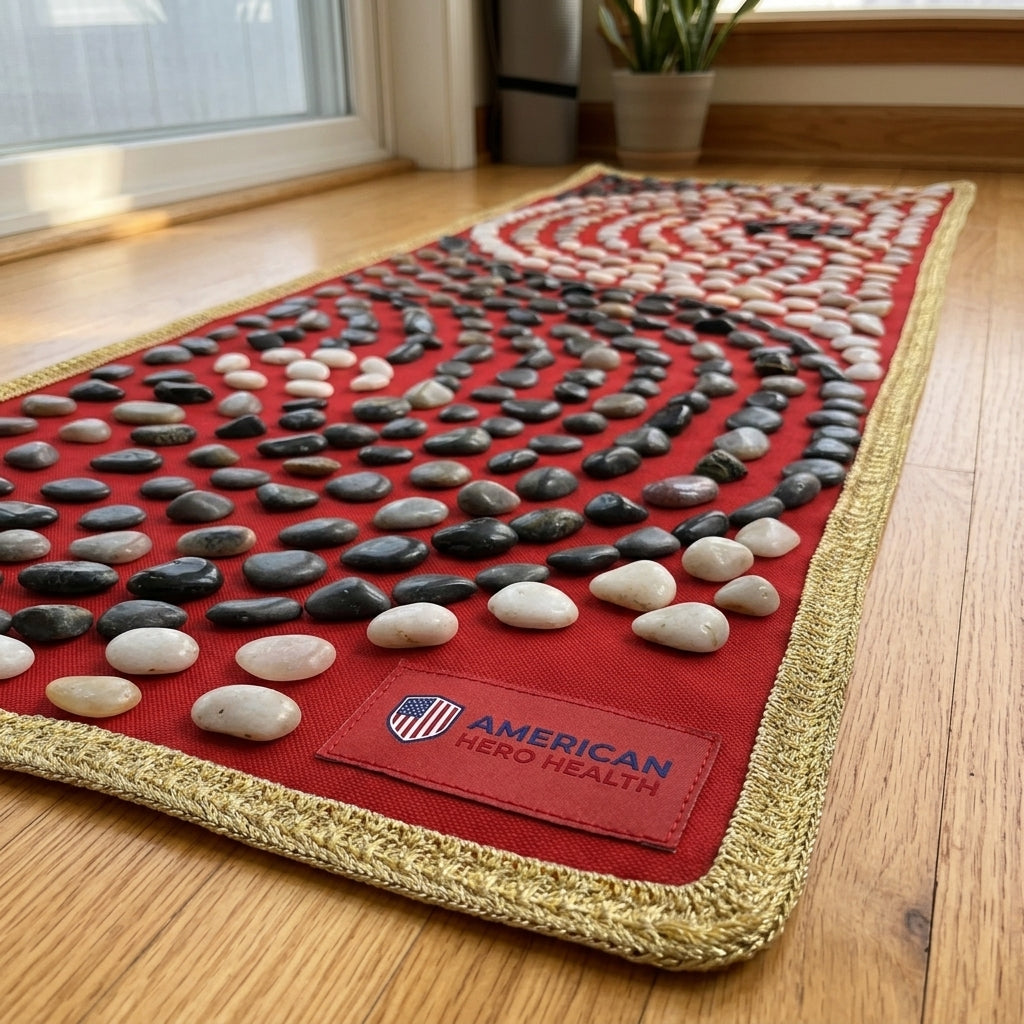
Two ways to build a foot mat: molded, or hand-set.
A molded rubber mat is cast from a single pattern, so the same ridge repeats in rows across the whole surface. It's an efficient way to manufacture at volume, and it's why most mats in this category feel identical to each other underfoot.
This one is built differently: individual river stones are set by hand into the base rather than molded as one piece, which is part of why the construction costs more to produce. Height and spacing vary slightly from stone to stone as a result of that process — it's a manufacturing difference, not a performance guarantee.
Seven parts of the construction

How it works
Compatibility & specs
Hand-set stone costs more to build than a mold does
Injection-molding a rubber mat is a one-time tooling cost spread across a large run. Setting individual stones by hand into a stitched, edge-bound backing is a slower, more labor-intensive process per unit, which is the main reason this mat costs more than a molded equivalent. The trade-off is a surface where the stones aren't identical to each other, at the cost of a more involved — and more expensive — build.
Questions before you buy
Does it hurt to stand on?
It should feel firm, not sharp. Most people find the first minute the most intense as their feet adjust, then the pressure settles. If any point feels genuinely painful rather than firm, step off and try a shorter session next time.
Can I use it if I have sensitive feet or a foot condition?
If you have diabetes, neuropathy, an open wound, or any diagnosed foot condition, check with a doctor or podiatrist before adding pressure-point stimulation to your routine.
Is it safe on all types of flooring?
The backing is a heavy, non-slip fabric — felt, heavy cotton, or PU-coated, depending on the version — built for grip on hard, flat surfaces like tile, sealed hardwood, and laminate. On thick-pile or plush carpet, the extra cushioning underneath it can let the mat shift slightly as you move, so a hard floor is what we'd recommend for a standing session.
How do I clean it?
Wipe the stones with a damp cloth and mild soap, then lay the mat flat to air dry before rolling it up. Don't submerge it or run it through a washing machine — the fabric backing absorbs moisture and takes a long time to dry fully, which risks mildew and can loosen the adhesive holding the stones in place.
Real pressure, not repeated texture.
One mat, a few minutes a day.
60-day money-back guarantee · Free shipping over $50 · Ships within 24 hrs